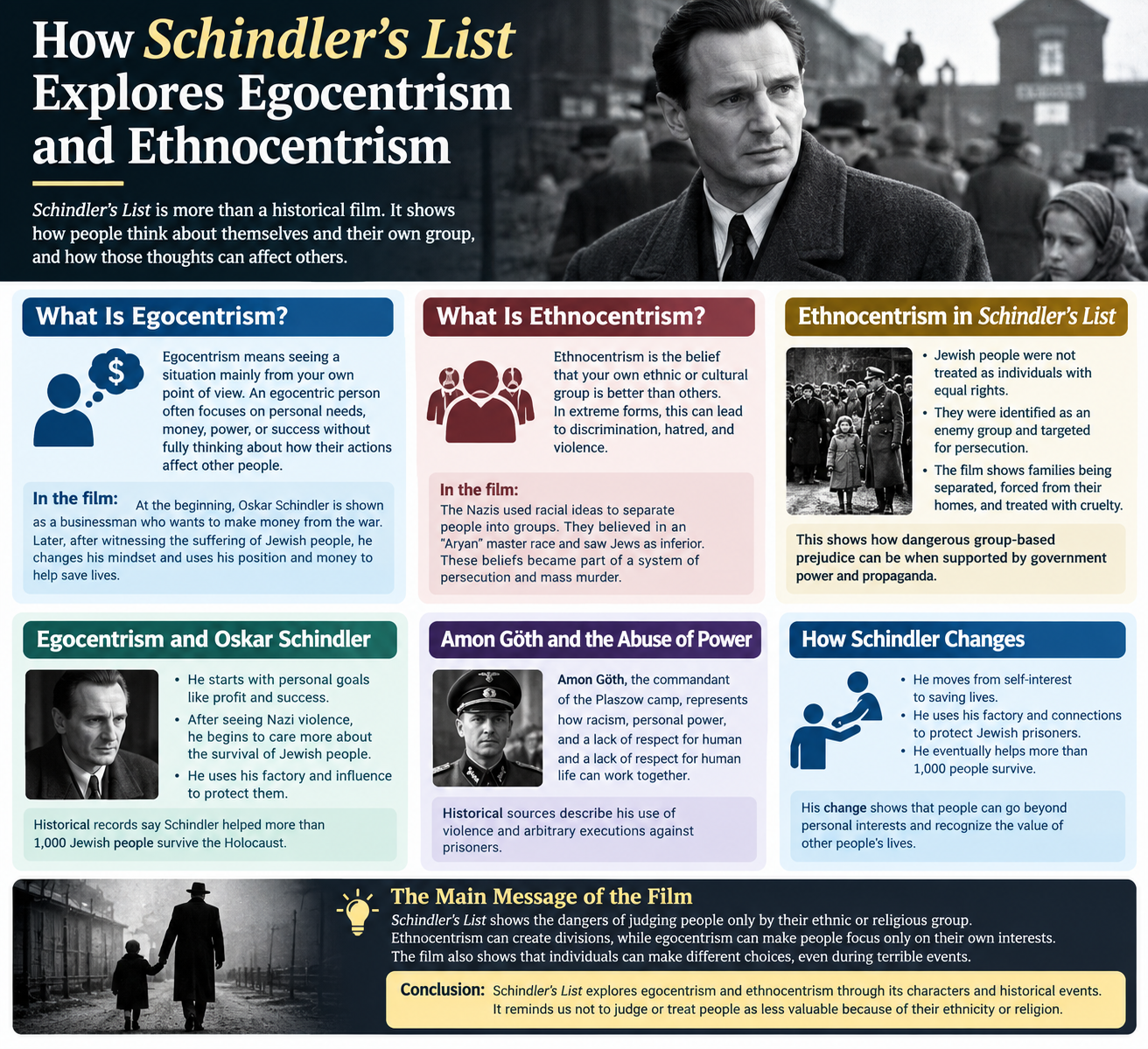
How Schindler’s List Explores Egocentrism and Ethnocentrism
How Schindler’s List Explores Egocentrism and Ethnocentrism
Schindler’s List is a powerful historical film directed by Steven Spielberg. Released in 1993 the movie tells the story of Oskar Schindler and the Jewish people he helped during the Holocaust. The film shows how people can think about themselves and their own group while ignoring the suffering of others.
Two important ideas that can be seen in the movie are egocentrism and ethnocen.trism
What Is Egocentrism?
Egocentrism means seeing a situation mainly from your own point of view. An egocentric person may focus on personal needs money power or success without fully thinking about how their actions affect other people.
At the beginning of Schindler’s List Oskar Schindler is shown as a businessman who wants to make money from the war. Historical records describe him as an opportunist who came to German-occupied Kraków hoping to become wealthy.
As the story continues Schindler begins to see the terrible conditions faced by Jewish people. His attitude changes and he starts using his position and money to protect Jewish workers.
What Is Ethnocentrism?
Ethnocentrism is the belief that one’s own ethnic or cultural group is better than other groups. In extreme forms this belief can lead to discrimination hatred and violence.
Schindler’s List shows how Nazi racial ideas were used to separate people into groups. Nazi ideology presented Germans as a supposed superior “Aryan” race and falsely described Jews as inferior. These ideas became part of a system of persecution and mass murder. The film shows how dangerous these beliefs can become when they are supported by government power and propaganda.
Ethnocentrism in Schindler’s List
One of the clearest examples is the treatment of Jewish people during the Holocaust. Jewish people were not treated as individuals with equal rights. Instead Nazi policies identified them as an enemy group and targeted them for persecution.
The movie shows families being separated people being forced from their homes and prisoners being treated with cruelty. These events demonstrate how prejudice against an entire group can lead to serious human suffering.
Egocentrism and Oskar Schindler
Oskar Schindler provides a different example of how a person’s thinking can change.
At first his main goal is business success. However after seeing Nazi violence against Jewish people he begins to care more about their survival. The U.S. Holocaust Memorial Museum notes that Schindler gradually changed and eventually used his money and influence to help Jews.
His actions show that people can move beyond personal interests and recognize the value of other people’s lives.
Amon Göth and the Abuse of Power
Amon Göth the commandant of the Plaszow camp represents another important part of the film. Historical sources describe his use of violence and arbitrary executions against prisoners.
In the movie Göth’s behavior shows how racism personal power and a lack of respect for human life can work together. His actions also provide a strong contrast with Schindler’s later efforts to protect prisoners.
How Schindler Changes
One of the main ideas in Schindler’s List is Schindler’s personal change. He starts as someone interested in profit but becomes increasingly focused on saving lives.
Schindler used his factory and his relationship with Nazi officials to protect Jewish prisoners. Historical records state that he eventually helped more than 1000 Jewish people survive the Holocaust.
This change makes the film’s message about human choices especially important.
The Main Message of the Film
Schindler’s List shows the dangers of judging people only by their ethnic or religious group. Ethnocentrism can create divisions between “us” and “them” while egocentrism can make people focus only on their own interests.
The movie also shows that individuals can make different choices even during terrible historical events. Some people supported persecution while others tried to protect those being targeted.
Conclusion
Schindler’s List explores egocentrism and ethnocentrism through its characters and historical events. The film shows how selfish thinking can change and how extreme group-based beliefs can cause discrimination and violence.
Most importantly the story reminds viewers that people should not be judged or treated as less valuable because of their ethnic or religious identity. It also shows the importance of individual choices during difficult times.
SEO Meta Description: Learn how Schindler’s List explores egocentrism and ethnocentrism through its characters Nazi ideology prejudice and Oskar Schindler’s changing actions.












Post Comment