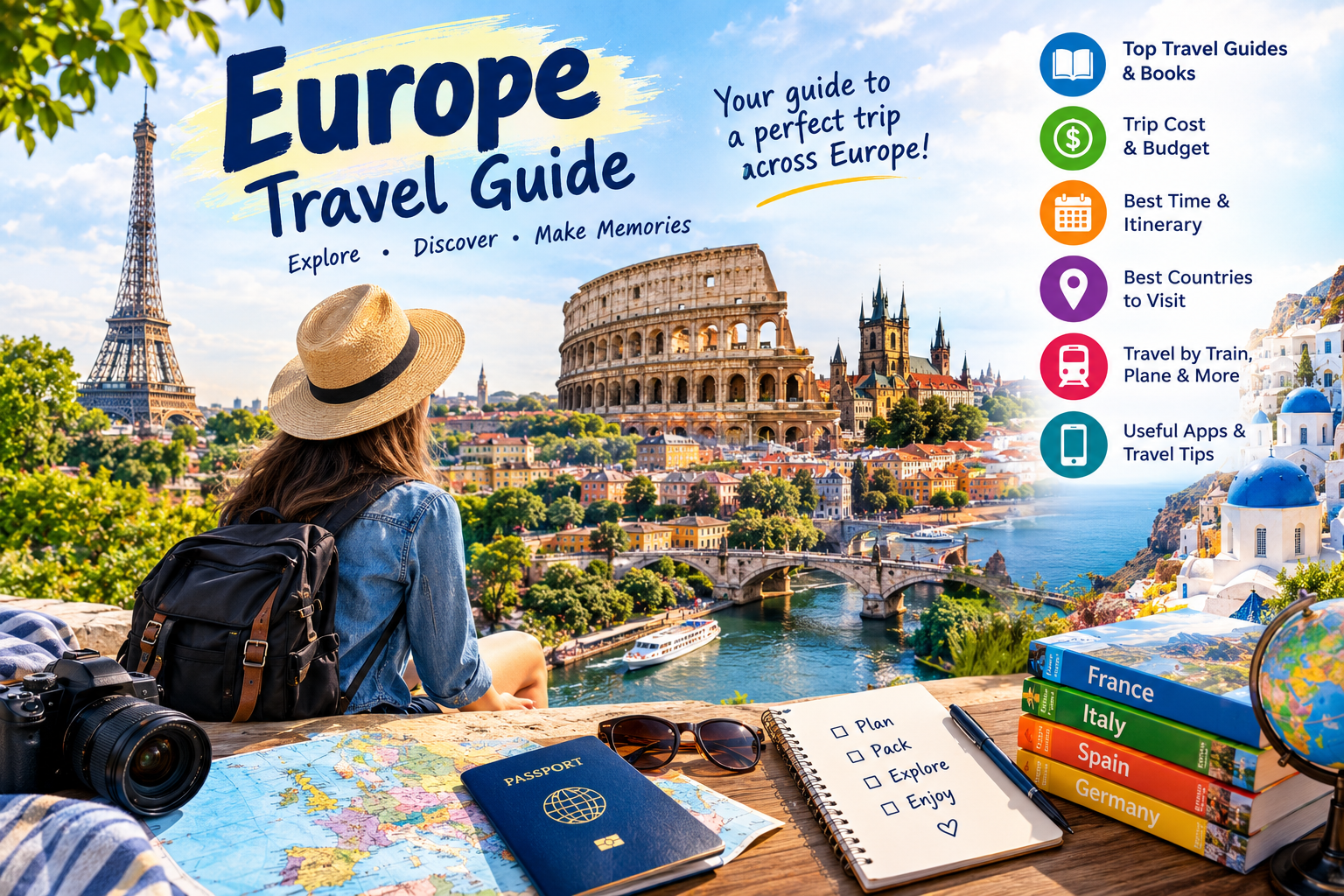
Europe travel guide
Europe travel guide
Europe is one of the most exciting places to visit. It has old cities beautiful beaches famous museums snowy mountains tasty food and many different cultures. You can visit several countries in one trip because many European cities are close to each other.
This europe travel guide will help you plan your trip in simple steps. You will learn about the best countries to visit travel costs how many days you need transport food hotels travel books websites apps and important travel rules.
What Is the Best Travel Guide for Europe?
The best travel guide for Europe depends on the type of trip you want. A first-time traveler may want a guide that explains famous cities transport hotels food and simple travel tips.
Popular travel guide books include Lonely Planet Europe and Rick Steves’ Europe. These types of books can help you learn about places before you leave. They can also be useful when you do not have internet access.
For current information an official European Union travel website can be more useful for entry rules and border information. The EU’s official travel information explains systems such as the Entry/Exit System (EES) and ETIAS.
A good travel plan can use both a book and online sources. The book can help with sightseeing ideas while official websites can help you check the latest travel rules.
How Much Will a Europe Trip Cost?
The cost of a Europe trip depends on your country choices travel dates hotel type food and activities.
As a simple planning guide a traveler may spend around:
- Budget trip: €50–€100 per day
- Mid-range trip: €100–€200 per day
- Comfortable trip: €200 or more per day
These are general planning estimates not fixed prices. Western European cities such as Paris London Amsterdam Zurich and Copenhagen can be more expensive. Some cities in Central and Eastern Europe can be cheaper.
Your flight can also make a big difference. International flights travel insurance visas when required and shopping should be added separately to your budget.
For example a 10-day trip might look like this:
| Expense | Budget Estimate |
| Hotels | €400–€1000 |
| Food | €250–€500 |
| Local transport | €100–€250 |
| Intercity travel | €150–€400 |
| Attractions | €80–€250 |
| Other costs | €100–€250 |
This means a 10-day Europe trip could cost roughly €1080–€2650 per person before international flights and some visa-related costs.
Booking hotels and trains early can sometimes help reduce costs. Traveling outside the busiest summer weeks may also give you more choices.
How Many Days Is Enough for a Europe Trip?
There is no single perfect number of days. However 10 to 14 days is a good length for a first Europe trip.
With 7 days you should choose one country or two nearby cities. Trying to see five or six countries in one week can make the trip tiring.
A 10-day trip could include:
- Paris – 3 days
- Amsterdam – 2 days
- Brussels – 1 day
- Rome – 4 days
For a two-week trip you can slow down and spend more time in each place.
Remember that travel between cities takes time. Packing going to the station or airport checking into a hotel and getting around can take several hours. Spending fewer days in more places is not always better.
Which Country Is Best for Travel in Europe?
There is no single best country for everyone. The right country depends on what you want to see and do.
France
France is a good choice for people who enjoy famous landmarks museums food villages and beautiful cities. Paris is the main attraction but places such as Nice Lyon and the French countryside offer different experiences.
Italy
Italy is great for history food art beaches and old towns. Rome Florence Venice Milan and the Amalfi Coast are popular choices.
Spain
Spain offers sunny beaches historic buildings lively cities and great food. Barcelona Madrid Seville Valencia and Malaga are popular places to explore.
Switzerland
Switzerland is famous for mountains lakes trains and clean towns. It can be more expensive than many other European destinations but its natural views are a major attraction.
Greece
Greece is a good option for travelers who want beaches islands ancient history and warm weather. Athens Santorini Crete and Mykonos are well-known destinations.
Germany
Germany has historic cities castles museums forests and famous Christmas markets. Berlin Munich Hamburg and Cologne are popular stops.
Portugal
Portugal can be a good choice for travelers looking for cities beaches food and a relaxed atmosphere. Lisbon Porto and the Algarve are popular areas.
The best country for your trip should match your budget interests weather preference and available time.
Travel Itinerary for First-Time Visitors
A simple itinerary can make your trip much easier.
7-Day Europe Itinerary
For one week choose two or three nearby places.
Days 1–3: Paris France
Visit the Eiffel Tower Louvre area Notre-Dame area and local neighborhoods.
Days 4–5: Brussels Belgium
See the Grand Place and try local food.
Days 6–7: Amsterdam Netherlands
Explore the canals museums and city center.
10-Day Europe Itinerary
Another option is to focus on Italy.
Days 1–3: Rome
Days 4–5: Florence
Days 6–7: Venice
Days 8–10: Milan or nearby northern Italy
This type of plan gives you more time to enjoy each city instead of constantly changing hotels.
Europe Travel Guide Book: Is It Worth Buying?
A Europe travel guide book can still be useful even when you have a smartphone.
Books can give you:
- City maps
- Hotel ideas
- Restaurant suggestions
- Sightseeing information
- Local history
- Travel routes
- Packing tips
- Cultural advice
A printed book is especially useful when your phone battery is low or you do not have mobile internet.
You can also use an e-book or digital travel guide instead of carrying a large book.
Europe Travel Guide PDF: Is It Useful?
A Europe travel guide PDF can be useful because you can save it on your phone or tablet before leaving home.
A PDF can include maps suggested routes hotel information packing lists and sightseeing ideas. However make sure you get travel information from a trusted source.
For visa and border rules always check official government or EU websites instead of depending only on an old PDF. Travel rules can change.
Best Europe Travel Website
A useful Europe travel website should provide information about destinations transport hotels activities and travel rules.
For official EU entry information the EU’s Travel to Europe website explains the current EES system and ETIAS. ETIAS is scheduled to start in the last quarter of 2026 and the official site says travelers should wait for the EU to announce the exact start date. The official information also says that ETIAS will apply to visa-exempt travelers from eligible countries visiting the participating European countries for short stays. Using official sources is important because many unofficial websites may show old or incorrect information.
Visa and Entry Rules
Entry rules depend on your nationality and the countries you plan to visit.
For short visits to the Schengen Area the normal short-stay rule is up to 90 days within any 180-day period for travelers under the applicable visa rules. Some travelers need a Schengen visa while others can enter without a visa. Your passport determines which rule applies.
The EU’s Entry/Exit System is now fully operational across the Schengen countries with electronic registration of certain non-EU travelers entering for short stays. ETIAS is different from a visa. It is a travel authorization for eligible visa-exempt travelers and is scheduled to begin in the last quarter of 2026. The current official ETIAS website says applications are not being collected yet.
Before booking your trip check the official requirements for your passport and destination.
Travel Europe Itinerary Tips
A good itinerary should be simple. Do not try to visit every famous city in one trip.
Here are some helpful tips:
- Choose two to four main destinations.
- Check travel time between cities.
- Book important hotels early.
- Leave some free time in your schedule.
- Keep copies of important documents.
- Check passport and visa rules.
- Buy travel insurance.
- Learn a few local words.
- Keep emergency contact numbers with you.
- Check the weather before packing.
One of the biggest mistakes first-time travelers make is creating an itinerary that is too busy. Give yourself time to enjoy the places you visit.
Journey in Europe by Train
Train travel is one of the most useful ways to move around many parts of Europe.
High-speed trains connect many major cities. In some cases trains can take you from one city center to another without the airport time needed for a flight.
For example train travel can be useful for routes between major cities in France Italy Germany Switzerland Austria Belgium and the Netherlands.
Compare ticket prices before buying. Sometimes an early individual ticket is cheaper than a rail pass while a rail pass can be useful for travelers making many train trips.
Travel in Europe by Plane
Flying can make sense when two destinations are far apart.
Budget airlines can offer low fares but remember to check baggage fees seat charges airport location and other costs. A cheap flight may become more expensive after extra fees.
For nearby cities compare the total travel time. A train may be easier even if the ticket costs a little more.
What Should You Pack for Europe?
Your packing list should depend on the season and countries you visit.
Basic items include:
- Passport
- Visa or travel authorization if required
- Phone and charger
- Power adapter
- Comfortable walking shoes
- Light jacket
- Basic medicine
- Travel insurance details
- Bank card and some cash
- Small day bag
- Copies of important documents
Comfortable shoes are especially important because many European cities are best explored on foot.
How to Save Money on a Europe Trip
Traveling around Europe does not always have to be extremely expensive.
Try these simple money-saving ideas:
Travel in the Shoulder Season
Spring and autumn can offer a good balance between weather crowds and prices.
Stay Outside City Centers
Hotels outside the main tourist area can cost less. Make sure the area has easy public transport.
Use Public Transport
Buses metro systems and trains can be cheaper than taxis.
Eat Like a Local
Local cafés bakeries markets and small restaurants can often cost less than restaurants in busy tourist areas.
Book Early
Flights hotels and some train tickets may be cheaper when booked ahead.
Europe Travel App: Do You Need One?
A travel app can make your trip easier.
Useful app features include:
- Offline maps
- Train and bus schedules
- Translation
- Currency conversion
- Hotel bookings
- Flight information
- Walking directions
Download important maps before leaving your hotel. That way you can still find your way when your internet connection is weak.
Common Europe Travel Mistakes
Even a good europe travel guide cannot replace careful planning. Avoid these common mistakes:
Visiting too many countries: You may spend more time traveling than sightseeing.
Ignoring travel rules: Visa and entry requirements should be checked before booking.
Packing too much: Large bags can be difficult on trains stairs and city streets.
Only visiting tourist areas: Local neighborhoods can give you a better feel for a city.
Forgetting travel insurance: Unexpected medical problems cancellations or lost bags can be expensive.
Not checking opening times: Some museums and attractions close on certain days.
Frequently Asked Questions
What is the best travel guide for Europe?
The best guide depends on your needs. Popular guidebook choices include Lonely Planet and Rick Steves’ Europe. For current entry and border rules use official EU travel information.
How much will a Europe trip cost?
A basic planning budget can be around €50–€100 per day for a budget traveler and €100–€200 per day for a mid-range traveler. Your actual cost will depend on the countries hotels food transport season and activities.
How many days is enough for a Europe trip?
Around 10 to 14 days is a useful length for a first trip. A seven-day trip can also work if you focus on one country or a small group of nearby cities.
Which country is best for travel in Europe?
There is no single answer. France is popular for art and food Italy for history and culture Spain for beaches and cities Switzerland for mountains Greece for islands and Portugal for cities and coastal areas.
Is Europe expensive to visit?
Some European destinations are expensive while others can be more affordable. Your choice of hotel food transport and activities has a major effect on the total cost.
Can I visit several European countries on one trip?
Yes. Many European countries are close to each other and train and air connections make multi-country trips possible. However visa and entry rules still apply.
What is the best way to travel around Europe?
Trains are very useful for many routes especially between major cities. Flights can be better for longer distances. The best option depends on price distance and travel time.
Final Thoughts
Europe offers something for almost every type of traveler. You can enjoy famous cities peaceful villages beaches mountains museums history and local food.
The key to a successful trip is good planning. Choose a few places instead of trying to see everything. Set a realistic budget check your travel documents book important transport early and leave time to relax.
Use this europe travel guide as a starting point then check official travel websites for the latest entry rules before you leave. With a simple plan and the right information your European adventure can be easier more comfortable and more enjoyable.














Post Comment