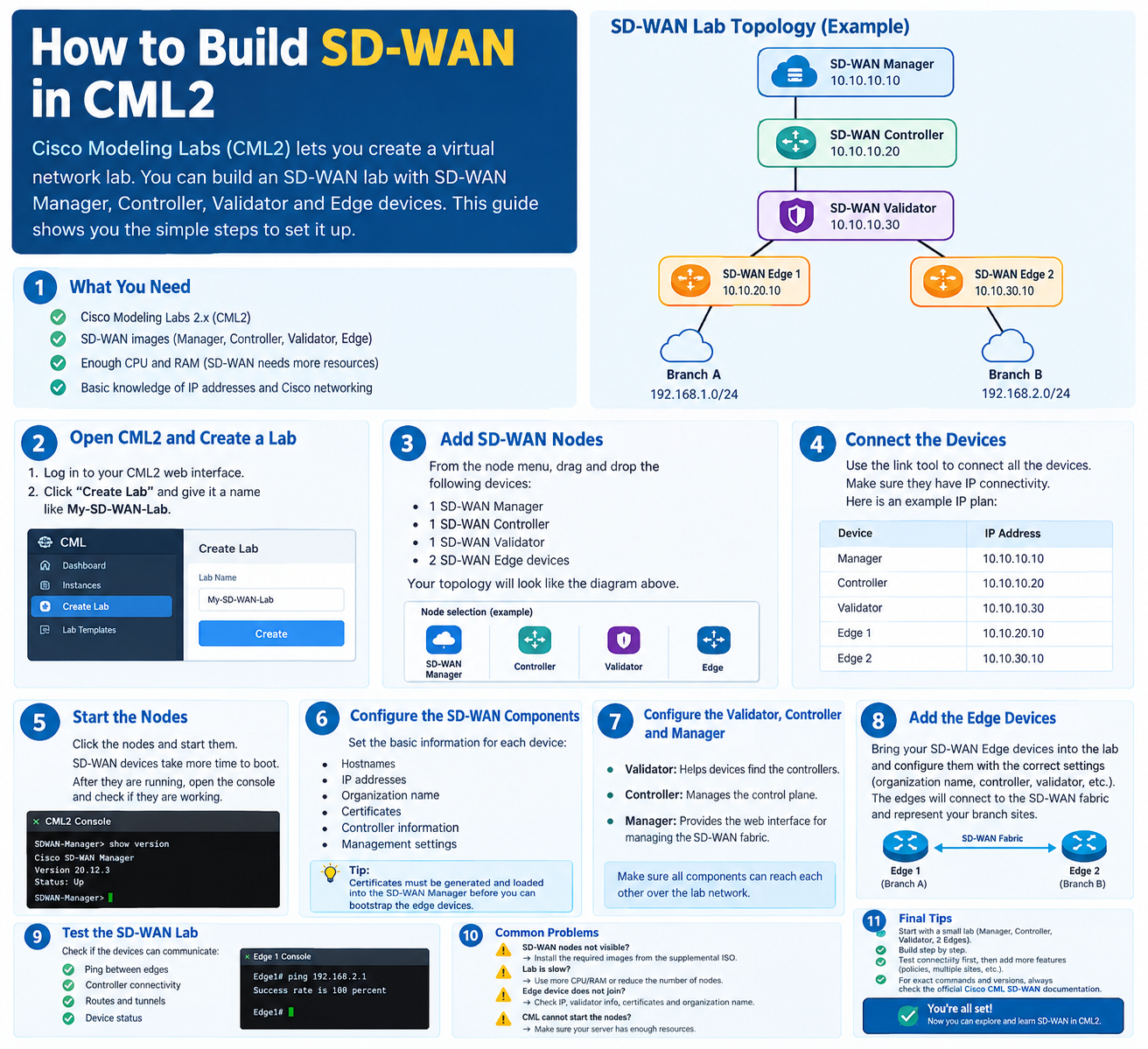
How to build sd-wan in cml2
.
How to Build SD-WAN in CML2
Cisco Modeling Labs (CML2) lets you create a virtual SD-WAN network so on your computer. First, create a new lab and add SD-WAN Manager, Controller, Validator, and Edge devices. Connect the devices and give them IP addresses. Then configure the basic SD-WAN settings and start to the nodes. Finally, test the connection between the Edge devices.
CML2 is a simple way to practice SD-WAN without by using physical networking equipment.
Cisco Modeling Labs (CML2) is a useful platform for practicing networking without needing a large amount of physical network equipment. You can also use CML to the create virtual routers controllers and other network devices in a lab environment. Cisco also provides the specific SD-WAN nodes for CML including SD-WAN the Manager Controller Validator and Edge devices.
If you are learning to Cisco SD-WAN building a small SD-WAN lab in CML2 can be a good way to understand how the different parts work together.
What Is SD-WAN?
Software-Defined Wide Area Network.
In a traditional WAN network devices are usually configured to one by one. SD-WAN makes to network management more the centralized. A central management system to can help control and monitor many network devices.
A simple SD-WAN setup to normally includes:
SD-WAN Manager – used to manage the network.
S Controller – helps control to the SD-WAN fabric.
Software-Defined Wide Area Network Validator – helps devices to find and connect to the SD-WAN controllers.
SD-WAN Edge – connects users and sites to the SD-WAN network.
Cisco’s CML documentation is provides in these SD-WAN node types for lab use. (
What You Need Before Starting
Before building to the lab make sure your CML installation is working correctly.
You need:
Cisco Modeling Labs 2.x
The required SD-WAN images
Enough CPU and RAM
A basic understanding of IP addresses
Basic knowledge of Cisco networking
Cisco’s current CML documentation lists SD-WAN Manager is Controller Validator and Edge images.
SD-WAN Manager is needs more to the resources than many normal CML nodes so make sure your computer or CML server has enough memory and CPU. Cisco lists 8 GB RAM and 4+ physical CPU cores as the minimum recommended resources for the default CML installation is although larger SD-WAN labs need additional resources.
Step 1: Open CML2
First log in to your CML2 web interface.
Create a new lab and give it a simple name such as:
My-SD-WAN-Lab
CML allows you to create network simulations using virtual network devices. (Step 2: Add SD-WAN Nodes
Open the node to selection me in to build sd-wan in cml2
For a simple practice lab you can start with:
Software-Defined Wide Area Network Manager
Software-Defined Wide Area Network Controller
1 SD-WAN Validator
2 SD-WAN Edge devices
Your basic topology can look like this:
SD-WAN Manager
|
|
SD-WAN Controller
|
SD-WAN Validator
/ \
/ \
Software-Defined Wide Area Network Edge 1 SD-WAN Edge 2
This is only a simple learning topology. A production network can be much larger.
Step 3: Connect the Devices
After adding to the nodes connect them according to your lab design.
You need to also provide suitable IP connectivity between the SD-WAN components. The exact addressing to the depends on your lab design.
For example you could use a small private network such as:
Manager: 10.10.10.10
Controller: 10.10.10.20
Validator: 10.10.10.30
Edge 1: 10.10.20.10
Edge 2: 10.10.30.10
These addresses are only examples. You can choose your own addressing plan.
Step 4: Start the Nodes
Start the devices in CML.
Give the nodes some time to boot because SD-WAN Manager and other controller components can take longer to start than simple router nodes.
Once they are running open their consoles and check that they are working.
Step 5: Configure the SD-WAN Components
Now you need to configure the basic information for your SD-WAN fabric.
This can include:
Hostnames
IP addresses
Organization name
Certificates
Controller information
Management settings
One important point is that Cisco’s CML SD-WAN documentation says SD-WAN fabrics do not simply use a normal full day-0 configuration like some other CML nodes. Certificates need to be generated and loaded into SD-WAN Manager before edge devices can be bootstrapped. Step 6: Set Up the Validator
The SD-WAN Validator helps SD-WAN devices discover the controllers.
Think of it as a meeting point that helps new SD-WAN devices find the correct SD-WAN control components.
Configure the Validator with the information required by your chosen SD-WAN version and lab design.
Step 7: Configure the Controller
Next configure the SD-WAN Controller.
The Controller is responsible for control information in the SD-WAN fabric. It communicates with the other SD-WAN components and helps build the control plane.
Make sure the Controller can reach the Validator and Manager over the lab network.
Step 8: Configure SD-WAN Manager
SD-WAN Manager provides the management interface for the lab.
From the Manager you can work with devices configurations policies and other SD-WAN settings.
Cisco describes SD-WAN Manager Controller Validator and Edge as the main components used to construct an SD-WAN fabric in CML.
Step 9: Add the Edge Devices
Now bring your SD-WAN Edge devices into the lab.
The Edge devices represent branch or site routers.
For example:
Office A
|
Edge 1
|
SD-WAN Fabric
|
Edge 2
|
Office B
You can use two Edge devices to practice communication between two different locations.
Step 10: Test the SD-WAN Lab
After the devices are configured check whether they can communicate.
You can test:
IP connectivity
Controller connectivity
Edge connectivity
Routes
Tunnels
Device status
Start with simple tests such as ping and basic connectivity checks.
If something does not work check the IP addresses interfaces certificates and controller information.
Common Problems
1. SD-WAN Nodes Do Not Appear
If SD-WAN nodes are missing from CML check whether the required images have been installed.
Cisco notes that the SD-WAN images are supplied through the supplemental reference-platform ISO.
2. The Lab Is Very Slow
SD-WAN components can require significant CPU and memory.
Try reducing the number of nodes in your lab or giving CML more resources.
3. Edge Device Does Not Join
Check:
IP connectivity
Validator information
Certificates
Organization name
Device configuration
Cisco specifically notes that certificates and the SD-WAN bring-up process are important before edge nodes can be bootstrapped.
4. CML Cannot Start the Nodes
Check your CML resources first. Cisco lists minimum CML server requirements but SD-WAN labs can need substantially more resources depending on the number of nodes.
Can SD-WAN Be Automated in CML?
Yes. Cisco’s documentation also describes automated deployment options for SD-WAN labs. An automation tool can help deploy components such as SD-WAN Manager Controllers Validators and multiple Edge devices.
This can be useful when you want to create larger practice labs without configuring every component manually.
Final Thoughts
Building SD-WAN in CML2 is a great way to learn the basic structure of Cisco SD-WAN in a virtual environment. Start with a small lab containing Manager Controller Validator and two Edge devices. Once the basic setup works you can add more sites policies and network features.
The most important thing is to build the lab step by step. First make sure the devices can communicate then configure the SD-WAN components and finally test the Edge devices.
For exact commands and version-specific requirements use the Cisco CML SD-WAN documentation because configuration details can change between SD-WAN and CML releases.









Post Comment